Like most of you, I played quite a few games this year, and I've had one or two interesting thoughts about most of those games. I'm not very good at end-of-year lists or rankings, so instead I thought I might just write a couple of paragraphs about the games that I remember of 2010, something I found interesting about those games, and some good pieces of writing I read about them. This won't be an exhaustive list, nor is it in any order other than the order that the games came to mind. Feel free to add your own thoughts in the comments, or links to any other interesting articles from this year. Suggestions of games I have missed are also welcome, but you might want to wait until I finish the series!
Bioshock 2

Nearly every review of Bioshock 2 that I read called it "the perfect sequel to a game that didn't need a sequel". For my part, it was a delightful return and fleshing out of a world I never expected I would visit again. I was wary the game would ignore the themes of the first game (much as the second half of Bioshock ignores its own themes when you are asked to continue taking orders mindlessly after the encounter with Ryan), but Delta's mental conditioning and the way it affects his decisions is blatant from the start. As you go on your quest for Eleanor, you know exactly why you are doing it: because you have no choice.
Gameplay and mechanics wise, Bioshock 2 improves on the first game's already solid systems nicely. The more open-ended design adds new dimensions to the city of Rapture and combined with the various new weapons and plasmids adds a whole new layer of potential tactics.
Bioshock 2's greatest achievement for me was that I truly felt like a Big Daddy. I felt big and bulky and heavy. My feet clunked on the timber flooring, my drill crushed the skulls of splicers, my rivet gun recoiled as the rivets punched through the air.
Also interesting was how my choices affected gameplay. Instead of the number of little sisters I saved just affecting what cut-scene plays at the end, it instead affected the kind of person Eleanor became and the decisions she made. Towards the end of the game, choices are no longer yours to make and you must stand by helplessly as Eleanor makes up her own mind. Yet, it was your decisions earlier in the game that determined the kind of person she became. You stand by helplessly, knowing that the choices you made allowed this to happen.
Probably my favourite Bioshock 2 related writing this year was Justin Keverne's "Groping the Map" series on Pauper's Drop. Definitely still worth checking out.
Mass Effect 2

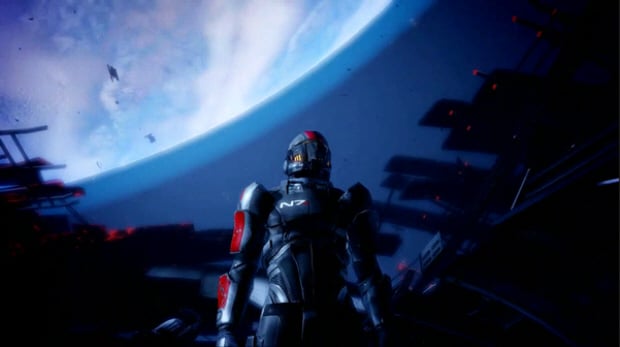
Mass Effect 2's cinematic trailer ranks as one of my all time favourite game trailers, just behind practically ever Grand Theft Auto IV trailer. It was good enough for me to finally play through Mass Effect so that I could play Mass Effect 2. Sadly, I found the game only a fraction as enjoyable as the trailer. After all of Mass Effect and more than enough hours of Dragon Age (by which I mean ten very dull hours) I am completely over Bioware's "gather a party and save the universe/middle-earth" plotline.
Which is not to say I couldn't at least appreciate Mass Effect 2 is a good game, just one I didn't enjoy. Unlike Dragon Age, the universe is at least interesting and well thought-out (even if you only get to discover most of it in the 'codex' menu). And the symbiosis between player and character in Commander Shepard is done superbly.
Yet, the gameplay was disappointing, and I couldn't help but feel I had done it all before. I didn't 'quit' Mass Effect 2 so much as just stopped playing one day and never started again. I just didn't see the point.
Minecraft

Rarely will I classify a single game my Game Of The Year, but 2010 has a clear winner in Minecraft. Probably the only release this year that I sunk more than a hundred hours into, and I don't regret a single one. Minecraft means something different to each player. I never built more than a single-room hut, and I was never more than a tourist on the various multiplayer servers. For me, Minecraft was about the lonesome exploration of new worlds. I spent countless nights exploring the deep places of various worlds, filling chests with diamond and redstone, then moving on to another.
The game could evoke emotions unlike any other game. Distress, anger, exuberance, sorrow, disbelief--all from a procedurally generated world with no set goals. That every action is final and irreversible certainly had a say in this. The experiences and memories I have from my all-night sessions of Minecraft easily surpass any other gaming experience I had this year. Surprising, considering I am usually one for the authored narrative.
And then there is Towards Dawn. What started as a simple musing tweet of "I wonder what it would be like to play as a nomad?" has turned into a forty-day-and-counting adventure across strange and beautiful lands. Though, it has stalled the last few weeks over Christmas, I'm afraid.
Many people wrote many things about Minecraft. Experience Points had many a good post, as did Rock Paper Shotgun with their "Mine the Gap" series and their Game of the Year post. Meanwhile, at Binary Swan, Gerard Delaney was one of the first to unwrap, for me, just why Minecraft feels so good.
Sleep is Death

For the few days after Jason Rohrer's experimental title was released, my brother and I played nothing else. The stories we created were quick, nonsensical, and improvised, written on-the-fly as we hastily found default sprites to further the story. The potential of the game was massive, but sadly I feel few have realised it. I guess the community it required just wasn't there in the way it was for Minecraft. That, or I am just unaware of it.
The greatest element of the game was cooperation. I've seen too many 'player' players play the game as though they were in competition with the 'director' player, a competition where they must break the story that the director has planned. Of course, this is a competition they usually win as breaking the story is easy. This isn't fun for anyone. It's like going left from the start of 1-1 in Super Mario Brothers then complaining when you can't go anywhere. Rather, if you cooperate with the director, the game can be an amazing experience.
In one of my brother's and mine first game, when neither of us really knew what we were doing, I managed to paint an entire scene blue by accident. My brother played along by saying "Ah! Flood!" So we went with this. His family jumped onto the bed and sailed it out to sea, living on a diet of fish until they found an island. It was these experiences that made this game awesome. Sadly actually setting up a game was always difficult and I have thus not been motivated to put much more time into the game in recent months.
Halo Reach

The end of the Halo series, as far as I am concerned, and also the most complete Halo title to date. Bungie has taken the best of the first Halo, added the improvements of the sequels, and removed the ideas that never quit meshed. The story and pacing is adequately tragic, with the helplessness of Noble Team mounting gradually at first then exponentially later. It only suffered from a lack of subtitles informing the player of how much time passes between missions. Some were actually weeks apart, and the missions would have made more sense if I was aware of this at the time.
The juxtaposition between your initial setup of Your Very Own Spartan(TM)'s armour with the customised, individualised helmet of said Spartan smoldering in Reach's rubble was excellent. Many people would have spent many minutes perfecting their ideal Spartan, excited that they would be seeing that Spartan in single-player as well as multiplayer. And then, the second they start campaign, they know that that Spartan, their Spartan, will be dead. It worked stunningly well.
I found matchmaking far more enjoyable than Halo 3, too, but that is mostly because I seem to not such at Reach while I sucked quite incredible at Halo 3. Firefight, however, despite the myriad of new options, I found somewhat lackluster compared to ODST. I can't quite put my finder on why, though. Perhaps it is the map design. Reach firefight is excellent for a short game, but it can't put a light to the multi-hour marathon's I had on the open levels of ODST.
Roger Travis wrote a great post at his Living Epic blog that looks at Halo Reach in the framework of the classic epic which is a bit heavy going at times, but is well worth the effort.
And that will do for Part One of 2010. To be continued tomorrow!