Hiển thị các bài đăng có nhãn Red Dead Redemption. Hiển thị tất cả bài đăng

Some Thoughts on 2010: Part Two

Yesterday I posted Part One of my 2010 retrospective where I am just writing a few paragraphs about the games I played this past year. Yesterday I covered Bioshock 2, Mass Effect 2, Minecraft, Sleep is Death, and Halo Reach. Part Two continues with games in no particular order.

Red Dead Redemption


Red Dead Redemption was easily my most anticipated game of 2010. No one can suck me in with a series of pre-release trailers like Rockstar. Grand Theft Auto IV is still my favourite game of this generation of consoles and the simple idea of 'GTA on horses' was enough to get me excited--as much as Rockstar urged that Red Dead Redemption was more than that. I was looking forward to the same level of incredible world-building, unforgettable characters, and biting dialogue (and hopefully without the same juvenile, gutter-trash dialogue).

My expectations were not surpassed so much as rendered null. In many ways, Red Dead Redemption is just GTA with horses, but in many other ways it is completely different. The characters are more plausible (if rarely any more likeable). The overall tone is more mature. The world is staggeringly beautiful in a way completely unlike Liberty City. Often I would just pause atop a mountain, mid-mission, just to watch the clouds over the plains.

The game does fall down in many of the same places Grand Theft Auto IV did. While many of the characters were more tolerable, few are likable. Rockstar's obsession with satire has rendered another world of empty, despicable characters. Then there is the notorious trek into Mexico where both the story and pacing go off the rails before the games final part brings things back together for one of my all time favourite game endings.

Red Dead Redemption was also responsible for some stunning pieces of games writing this year, too. Michael Abbott's battle with Armadillo's anti-semite shopkeeper was an early favourite. Another great piece of writing seems to have disappeared from the internet, I am afraid. I distinctly remember reading this piece where a player was playing as a pacifist, walking around a multiplayer free-roam map just tracking wildlife and being murdered by more violently-inclined players. If anyone knows the piece I am talking about, I would greatly appreciate a heads up in the comments. EDIT: If anyone can track down a piece of games writing on the internet, it is Ben Abraham, and he came through for me this time. Here is the piece I was thinking of: "Call of the Wild West" by Brendan Caldwell.

VVVVVV


Another great indie title for 2010, VVVVVV is a straightforward platformer that takes the core mechanic (jumping) and tweaks it to completely change how you approach the game. Instead of jumping, in VVVVVV you flip. When the flip key is pressed, the character falls up until they hit the ceiling, where they will stay until you flip back and fall down to the floor. In the same vein as Portal, this change meant that I had to completely rethink how I approached puzzles that I had already solved a dozen times in previous platformers with a simple jump.

The game's presentation is slick, too. I can understand if some people have had enough of the latest retro trend, but VVVVVV's 8-bit graphics and chiptune soundtrack is stunning. It is on Steam these days, too. Strongly recommend you check it out if you are yet to.

One Chance


An interesting and memorable little browser-based game that forces you to make decision and then live with them. In a way, One Chance is a perma-death experiment. Every decision you make is final. You cannot restart; you cannot try again. And when you complete the game, that is it; you cannot start again.

Interesting, that I found a game that I spent little more than a quarter-hour playing memorable enough to including on an end-of-year list. Or perhaps that isn't surprising at all. When games force the player to live with their decisions, the player will have a more meaningful experience, just as Minecraft forces the player to perpetually move forward in time.

When faced with permanent consequences, you might be surprised by the decisions you make. It has a few bugs, but generally runs quite smoothly. It will only take about ten minutes to play and is really worth trying out.

Just Cause 2


I almost missed this one. When it first came out, I played the demo, enjoyed it, but not enough to consider buying the full game. This last fortnight, though, I found it on sale and decided it was time. The story is terrible and the voice-acting even worse (what is with that woman in charge of the communist faction?) but the game beneath it is crazy fun.

Overall, the game feels like San Andreas combined with the rope tool of Garry's Mod. What makes the game work is its systems. Everything is tweaked in just a way to ensure cool stuff always happens. For instance, when you leap off a car and open your parachute, the car will only need the smallest impact to explode and add some extra drama to your escape. Or, my personal favourite: maybe two missions into the game I was being chased by men in jeeps. I did not expect it would work, but I tried to use my grappling hook to anchor one jeep to the road. Sure enough, the jeep lurched forward to forward-flipped onto its roof. There is little more satisfying in a videogame than when you think "I wonder if..." and then you actually can.

The central play-style of the game is also well-treated by the the fiction. The story of mercenaries and agencies is disposable, but the central concept of having to cause chaos to unlock missions and weapons ties in well with the sandbox 'dicking around' themes of the game.

Not that you need the motivation, just moving is fun. Jumping from a helicopter to land on a motorbike to then leap off just as it explodes into a service station as you leap onto the front of another car and then back up into another helicopter is just pure, rollicking fun. How long it will remain fun without a story worth caring about, however, I can't yet say.

Nels Anderson has a great post about the absurdity and possible campness of Just Cause 2, which I enjoyed reading many months before I played the game.

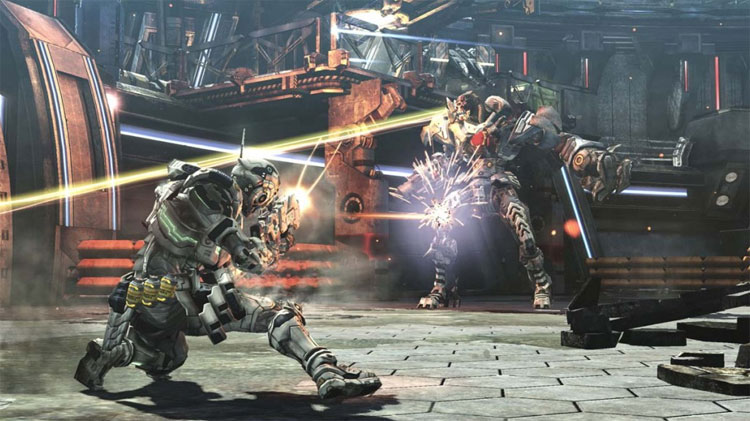
Vanquish


I never enjoyed Devil May Cry or Bayonetta. I don't dislike them, mind you. I can appreciate that both are very slick games, but I just don't enjoy them. So I was very excited when I tried the Vanquish demo and actually enjoyed it. It's a fresh take on the cover shooter in that it punishes you for staying still--an odd move when your central mechanic is taking cover.

The star of the game is not the cover system or the guns or the horribly cliche characters, but the suit that will have you boosting, cartwheeling, sliding, and throwing oversized missiles back at oversized mechs. Interestingly, you do not acquire upgrades for the suit as the game progresses. You finish the game capable of nothing you could not have achieved at the start of the game. Rather, it is your understanding of the suit and what you can do with it that must improve. The stead learning curve complements this nicely and by the end of the game you will be darting around like an expert, ready to begin again on the next difficulty setting.

Similar to Just Cause 2, the story is an absurd throwaway... perhaps. I have a theory that Vanquish's story is not cliche so much as it is a deliberate, tongue-in-cheek parody of western videogame tropes. I have a half-written blog about this that I will hopefully get finished in the new year if I ever get the time to say it. Suffice to say, I'm not sure if Vanquish is the Japanese response to the Western shooter, or the Japanese pointing and laughing at the Western shooter. Perhaps a little of each.


And that is Part Two and five more games down. Unless I think of more that I have forgotten in the next couple of days, I will have ten more games across two more parts in the coming days.

Frayed Narratives, Closed Games: Understanding My Allergy To BioWare Games


I do not enjoy many BioWare games. There I finally said it. Baldur’s Gate overwhelmed me; I gave up on Knights of the Old Republic; I could not stand Dragon Age: Origins. I did enjoy the story and style of Mass Effect a lot, but it took months of apathy towards the gameplay before it obtained the dubious title of being the only BioWare title I have ever completed. I am currently halfway through Mass Effect 2, but the disc has not been placed in my 360 for over a month now. I just do not feel the need to complete BioWare games. There is something about them that just makes the overall experience meaningless to me.
This has always bothered me as I do not think BioWare make bad games. Many would argue, and I would have trouble disagreeing, that they are among the best world-builders (in the fiction sense, not the polygon sense) in the industry. They form worlds rich with details, bureaucracies, and consequences that make other game-worlds look like flat, cardboard cut-outs. Games like Dragon Age have an unprecedented amount of recorded dialogue so that the player’s actions can affect the story, world, and characters in meaningful, persistent ways. These games integrate story and game so tightly that the two can’t be separated. These should be the games that justify my belief that games can tell good stories in ways pre-existing mediums never could. Yet I do not enjoy them.
Meanwhile, I thoroughly enjoy games such as Red Dead Redemption, Fallout 3, and Halo 3: ODST that give me some arbitrary amount of spatial freedom to move around an open world, yet force me through an ultimately linear narrative. These games let me do whatever I want, but then remove my agency entirely to progress the story in a certain way. If I would rather be told a pre-authored story than author my own, why do I invest so much time into playing and researching story-driven games instead of film or literature?
This question has pestered me for some time now. It would not be exaggerating to say I feel guilty for enjoying these games while not enjoying the BioWare titles—to the extent that I have even doubted my own belief that story has a place in game design. It was not until the following passage from Tom Bissell’s Extra Lives caused me to stop and think for whole minutes that I began to understand why: 

"I want to be told a story—albeit one I happen to be part of and can affect, even if in small ways. If I wanted to tell a story, I would not be playing video games."
Before I go on, it must be stressed that this can only ever be a purely subjective thing. I am not trying to argue for one form of storytelling over another. There is no single, prescriptive way to put stories and games together. I am not trying to disregard the BioWare model (that would be foolish as so many people obviously do enjoy their games) but, rather, I want to understand why the BioWare form of storytelling does not appeal to me.
If a game such as Red Dead Redemption is a closed story (one beyond my control) in an open world (one I can navigate freely), then a BioWare game such as Dragon Age is an open story in a closed world. Or, instead of ‘world’, let’s say ‘game’; that way I am not limiting my argument to sandbox games. Both Deus Ex and Metal Gear Solid, for instance, are closed stories beyond my control (my actions do affect which ending I view but each possible ending is still predetermined), but are open games in the sense that I am able to navigate and interact with the levels freely—even in ways that render the story nonsensical.
Dragon Age, on the other hand, feels like a closed game which does not give me any freedom to navigate or interact with the world. That is a contentious thing to claim that can easily be argued against, I am aware. However, each Dragon Age locale that I visit feels confined and contrived; I can talk and interact with characters to progress the story, but can only interact with the world—and by extension, play the game—in very limited ways.
Despite the rich depth of fiction supporting Ferelden, I never feel like I am visiting places, just levels. Shadow Moses Island and Deus Ex’s Liberty Island, despite the linear stories the games force me through, feel like real places. Metal Gear Solid and Deus Ex only allow me to interact with the story in limited ways, but I can interact with their worlds (and thus their games) in significant ways. Dragon Age, however, while letting me interact thoroughly with the story, rarely lets me interact with the game.
By closing off the game and opening up the story, BioWare games give me agency where I do not require it, and remove my agency from where I do require it. That is, I am able to affect the story more at the price of being able to play the game.
Narratives are essentially linear. Some are convoluted with flashbacks and various points-of-views and whatnot, but every narrative essentially starts at a beginning and progresses towards an end. Games have some fascinating contributions to make to storytelling discourse. One is allowing unique player experiences to emerge from the act of play in games such as The Sims or Far Cry 2. Another is allowing the player to partake in existing narratives by enacting a specific character role. However, I am increasingly convinced that one of these contributions is not the delinearisation of what are still essentially pre-authored narratives.
I feel that if a game has a particular story to present, it should present it. As the Bissell quote above states, I do not play games because I want to tell stories; I play games because I want to take part in a story. I want to enact a role in the game’s story, not rewrite it. The actor playing Romeo in a production of Romeo and Juliet does not get to decide whether or not he kills Tybalt, but he does get to decide how he personally, uniquely enacts the character of Romeo within the open space of the stage and the closed space of the narrative. Like the actor, the player guides a linear narrative through an open, navigable space.
Arguably, the branching dialogue trees of Mass Effect and Dragon Age are just a higher degree of this: taking part significantly in a story that is being told to me. However, for me this can never be more meaningful that those pick-a-path novels you read as a kid. I do not feel as though I am experiencing my own, personal telling of the story; rather, I merely feel like I am experiencing one of an arbitrary number of hypotheticals. Red Dead Redemption is the story of John Marsden; Deus Ex is the story of JC Denton; Metal Gear Solid is the story of Solid Snake. Dragon Age, however, is not the story of one specific character; it is the story of how a Grey Warden who may exist (but then again may not) may save Ferelden this way (but then again may save Ferelden that way). While the game’s efforts to give the player agency over the story should be applauded, the actual result was that my actions became less significant. The numerous potential paths of the narrative weakened my overall experience of the story. My actions were less meaningful because any other combination of actions could have had the same ultimate result. Ultimately, the story lacked authority.
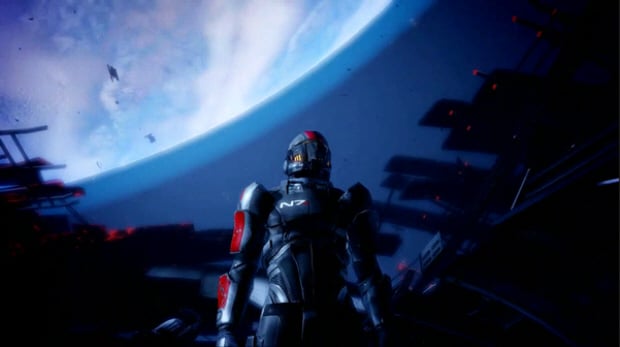
This is perhaps why Mass Effect is the only BioWare game I have actually completed. Although the player has an impressive amount of influence over what kind of person Shepard is, Mass Effect is ultimately the story of Commander Shepard, not of the player, and it is a stronger story because of this. And, as a game relying primarily on its story, is also a stronger game.
A linear story threads through an open game like a thick rope that anchors and guides the player’s actions. BioWare’s multi-branching narratives are not multiple ropes, but one rope much frayed. The number of paths is not increased (they all still end in a similar conclusion), but the overall strength of the narrative is weakened. Branching narratives is not the way to go about allowing the player their own personal stories. Games can do this, but no pre-authored narrative can. Mass Effect, with all its dialogue trees, will never have the breadth of unique stories that have emerged from more emergent games like The Sims or Far Cry 2.
This is not to completely undermine al the incredibly things Mass Effect and other BioWare games achieve. The predicament with Wrex will go down as one of my more gripping gaming moments of recent times. BioWare does an extraordinary job of making me feel for its characters and worlds. However, I believe that is more a product of their splendid, encyclopaedic knowledge of their worlds than from any number of dialogue trees.
I have no issue with linear narratives in games, and I have no issue with open, emergent narratives in games. I also have no issue with games experimenting with linear narratives in new ways. However, I do have an issue with linear narratives trying to be emergent narratives. At best, they will be complex pick-a-path stories, nothing more.
This is why I find Mass Effect the most enjoyable of BioWare’s titles. It is a linear narrative about Commander Shepard fighting the Reapers. The player is able to participate in the narrative by making significant choices along the way, but the narrative itself remains the same. This is the story of Commander Shepard. Dragon Age, however, gave me no reason to commit to its narrative as the game itself felt uncommitted. It was not a story; it was one branch no more remarkable than a thousand other branches.
It is not the number of narrative paths that fascinate me about a story-driven game—a game based on emergent play will always have an infinite number more. Rather, it is the ability to take part in one specific, well-presented narrative path that interests me. I am a player and, by definition, my participation is in the gameplay; it is in the gameplay that my agency can do the most good. Narratives, historically, have always worked best when linear and closed off from the audience’s input; gameplay has always worked best when left open to the player’s experimentation. So perhaps, instead of merging the two together, games should keep it that way. Give the player a point A and a point B and a navigable space between the two and let them find the rope to pull them through it.

As noted throughout this article, I am not trying to be prescriptive here. I am very aware that many people do enjoy these BioWare games for exactly the reasons I do not. Perhaps I am simply approaching them with the wrong frame-of-mind. I can already see some key weaknesses in my arguments that could easily be argued against (i.e. How can I say the player has significant choices in Mass Effect if the narrative is unaffected?). I welcome challenges to the conclusions I have drawn here in the comments. Not because I think I am right, but because I want to understand why I do not enjoy these games.

Moments 02: Red Dead Redemption

[In this less-regular-than-initially-anticipated section, I record some of my more memorable gaming moments, the moments that remind me why I play games. In this entry I describe my feelings as I played the epilogue of Red Dead Redemption. If you are yet to finish Red Dead Redemption, I strongly recommend you do not read this post as it shall spoil a calibre of ending not enough seen in videogames.]


My mother is dead. It happened suddenly—very suddenly. I didn’t even really note the time passing: three years since we buried my father, three years since The Law betrayed him, betrayed us. I guess ma died from grief, or just gave up, or something of the sort. After all, if this is no country for men like my father, what kind of country is it for women like my mother? It doesn’t matter now; what matters is that they are both dead. There’s a gap in the soil between their graves and Uncle’s, just enough room for one more.
For me.  
But first, I have business to settle. Pa tried for redemption, but that didn’t go down so well, did it? No, I won’t try for redemption. Revenge will be my game.
I take Pa’s gun, the same gun that saved me from that grizzly three years back, when I was cocky enough to think I could shoot. Well now I know I can shoot. I dig my heel into the stead and leave my ranch for the last time, rifle on my back, and make for Blackwater. I’m furious. My revenge cannot come soon enough.
I have no plan. I am too angry to have a plan. My dad wanted to change, god damn it; why did they have to kill him? The anger is swelling somewhere in my gut, and I just want to make as many of them pay as possible before it consumes me utterly. Lawmen, men, women, dogs, horses, I don’t care. I am going to shoot the first moving thing I see.
But lo and behold, fate shines on the people of Blackwater this day. Before I see a single person (perhaps the foul weather is keeping them inside, perhaps a communal sense of foreboding), I notice the question mark symbol on my radar: a stranger. Some unfinished business of my father, perhaps?
The first person I see, then, is a federal agent—his bowler hat gives him away. A plan forms in the part of my mind that is still thinking. This is not my father’s unfinished business; this is my own chance to do something with the anger threatening to burst within me. I tell the man I have a letter for Edgar Ross and, to my surprise, the agent tells me where to find him: Lake Don Julio. I leave without another word. I still consider razing the town on my way out, but resist. My revenge has an aim now. I will let it build up inside of me, eat me from the inside as I gallop to Don Julio, and then I will let it all out in one relieving sigh.
So begins my journey across the same lands my father traversed those years earlier. I pass McFarlane’s ranch mere hours after leaving Blackwater. This is urgent. I know that if I do not vent this anger soon, something bad is going to happen. I dig my feet into the stead, desperately. I ride the poor animal within an inch of its life.
“Hey! You!”
A lawman waves at me from a crumpled wagon, one wheel lies detached in the grass. Another lawman’s bloodied body is crumpled nearby.
“A criminal we were transporting escaped! Shoot him or bring him back alive!”
I look at the lawman for full seconds. My options are clearly highlighted at the bottom of the screen: “Shoot the outlaw or return him alive to the lawman.” I can still see the criminal staggering across the barren land; I could be overtaking him within seconds. Hell, I could probably shoot him from here.
I shoot the lawman in the face and continue to Lake Don Julio.
It felt good; I won’t deny it. Sure, at the back of my mind I realise I have just killed a man, possibly a good man. But what of it? I killed him because of what he represented. The anger still bulges under my skin, but it is held at bay for just a bit longer.
At Lake Don Julio, I find Ross’s wife. He has gone south, to Rio del Toro with his brother. His wife is polite and kind. I consider killing her, just to get to Ross. Perhaps I could take away his family, show him what it is like. Part of the reason I don’t do this is because I am concerned the Stranger format of this mission would fail if I killed her, but mostly I like to think I would have let her live regardless. I try to tell myself that I spared her because I am a better person than Ross. I don’t quite believe it.
On to Mexico.
“Help me! Help me!”
Mere seconds after crossing the border, a woman is waving me down, asking for assistance. It is a half-hearted attempt—I can see the boots of the bandits waiting in ambush behind her wagon. Pa often encountered this set up. He told me how he always let the girl go, that it was rarely her choice to be involved in such a heist.
I shoot each bandit in the face with my revolver. The girl begins to beg for her life, but gives in and starts running after I shotgun the second horse. I calmly finish off the third and forth horse before I chase her down. I don’t even slow as I fire the shot, nor do I look back to see if it finished her.
I find Ross’s brother camped under a tree by the river. He tells me Ross has gone downstream to hunt ducks. Once again, I consider killing him to get to Ross but again I resist. My next bullet is for Ross.
Do I think killing Ross will prove anything? Of course not. Do I care? No. This isn’t about doing the “right” thing. There is no right thing. Pa tried to do the right thing and they killed him. This is about releasing the black blob of anger that is taking me over. This is about removing from me the impulse to gun down every god-damned man, woman, and creature I pass.
Ross speaks to me; I don’t listen. He hasn’t even removed his pistol from its holster when I empty my revolver into his face.
And that is it. There is a brief moment before his corpse slides into the river where I can see the crumpled mess I have turned his face into and, in that second, the anger is purged from my body. It is like a drop in pressure—abrupt, nauseating, violent. I see things with such a sudden clarity that I feel like being sick.
Pa found his redemption when he chose to leave his life of crime behind. Pa found his redemption when, even after the government kidnapped his family and forced him to hunt down his old gang, he did not seek revenge. Pa found his redemption when he knew they would come back for him but refused to run away. Pa found his redemption by leaving behind a family that could look after itself.
The government and its lawmen did not take away Pa’s redemption. Edgar Ross did not take away Pa’s redemption. I did. The dirt has not even set on my mother’s grave, and I have become everything both her and my father tried so hard to leave behind.
I holster my pistol and walk back to my horse. I take one last look at Ross’s body bobbing to the ebb and flow of the river, and ride away. I try not to think of his wife and brother. I try not to think about how I have failed my father. Instead, I think to the future, of how I could possibly make up for these sins, of how I could find my own redemption.

Game Diary 03: 03 June 2010


[Game Diary is a semi-regular column reflecting on the games I am currently playing, articles I have recently read, and writings I am currently working on.]

It has been quite some time since my last Game Diary entry. I can put this down to one major excuse: Red Dead Redemption. Though, ModNation Racers as well as cheap copies of Mass Effect 2 and Final Fantasy XIII have not helped matters either. I now find myself in the unenviable position of having three hundred-plus hour games to complete along with plenty of articles and essays to write, and great articles to read.

Games I Played
Red Dead Redemption. Where to begin? What to say about this game that you have not already heard? While I know many of you will disagree with me, I feel Rockstar are doing some of the most exciting work out there in terms of incorporating mature, intelligent stories into videogames. I know Red Dead Redemption is created by a different team than Grand Theft Auto IV, but Dan Houser is still a major writer (if the opening credits are to be believed), and it certainly shows. The entire game drips with intelligent satire and knowing nods to the Western genre--staying true to the aesthetics and iconography while also critiqueing it with a contemporary eye. Rockstar's biting satire remains but the potty humour and mention of titties has (thankfully) largely been left in Liberty City.
The map is sprawling and vast, yet full of things to do. I rarely feel the urge to quick travel; this is the kind of world that begs you to take your time exploring. Shooting is more fun than in Grand Theft Auto IV, and actually quite challenging once you turn off auto-aim. My only major criticism is that every mission is basically the same predictable structure (ride somewhere, shoot stuff, ride back), but there are a few delightful surprises. But even when the missions are all the same, the scriptwriting and presented fiction are all so tight that I hardly mind galloping into Armadillo one more time.

ModNation Racers. I won't repeat everything I have already said in my post on this game, suffice to say that it is an excellent, enjoyable racer hidden behind a horrible mish-mash of laggy, un-navigable menus.

Mass Effect 2. I made the mistake of walking past EB Games the other week just as their stocktake sale was commencing. Before I knew it, I had picked up half-price copies of Mass Effect 2 and Final Fantasy XIII--both games I intended to play "one day" when they didn't cost $100. I guess it is that day! 
I have something of an allergic reaction to BioWare games, I admit. I don't know what it is. Every since Knights of the Old Republic, I have started a game with high hopes after hearing nothing but positive things, and then I just get... over it, I suppose, quite quickly. Perhaps not 'bored' so much as 'intimidated'. Perhaps BioWare's stories, which I really do have some control, scare the crap out of me and, afraid of the responsibility, I run back to my more predictable, linear games. Well whatever it is, I am glad to say that Mass Effect 1 was the exception to my BioWare fallacy, and Mass Effect 2 seems likely to continue the tradition. i am glad that they have stripped back (or hidden away) the role-playing elements; though, it would have been nice if they had fine tuned the combat a bit more to make up for the lack of number-crunching depth. But it is early days yet, perhaps when I stop relying on my pistol and single tech skill it will get a bit more involving. That said, the graphics are still slick, the voice acting is still incredible, and the world(s) are still beautiful. I'm looking forward to putting a heap of hours into this one when I get the chance.

Final Fantasy XIII. Okay. I admit I have not actually played this yet, but my girlfriend has, and I have been sitting nearby for the five-ish hours she has played so far. So far it seems to be exactly as every review and article I read about it says: one incredibly slow grind that drips abilities and options to the player at the slowest pace imaginable, as though the game is afraid the player could not possibly handle two 'new' concepts at once (as if anything in Final Fantasy is new anymore). Though now, after five hours, the combat is looking a lot more compelling and I am more tempted to start up a game myself.
The scriptwriting and voice acting, while still not amazing, seems a great deal better than any previous Final Fantasy. I particularly like all the tensions and strains between the various characters. And all the nods to Final Fantasy VII are enjoyable and appreciated.


Some Things That I Read.
"I'm Your Huckleberry" at The Brainy Gamer. An entertaining and well-written little piece telling the tale of one player's perpetual fight with an anti-Semite shopkeeper in Red Dead Redemption.
"Groping The Map: Pauper's Drop" at Groping The Elephant. Justin Keverne has set himself a huge challenge of writing these massive, multi-part articles that thoroughly walk through specific game levels and explore how those levels use space and their mise-en-scene to guide the player. His first installment, on the Bioshock 2 level Pauper's Drop is nearly all up (five out of seven sections!) and certainly worth the read. Justin has a great critical eye for the ways the level manipulates and directs the player, and how the player understands the world through the level. As someone who has a great interest in videogame level design but absolutely no formal education in the matter, I'm finding these posts as educational as they are interesting.
"Video Games, I've Let You Down" at Kotaku. Leigh Alexander's piece about the difficulty of trying to explain why videogames can be great to non-gamers strikes pretty close to home. A good read.
Practically all of EDGE E215. Alas, my subscription to EDGE ran out at E214, and then E215 has a whole bunch of great articles. So I went and bought myself a copy from a shop, once they finally got it imported, and then went home and renewed my subscription. The retrospective on Halo is especially interesting, as it is a far greater version of a piece I have wanted to write for some time. Halo is a spectacular game, fanboy-love aside, and I think this piece does a good job at justifying why. The Time Extend on Sim City 4 made me pick up a cheap copy (I haven't played a Sim game since SimCity on SNES), and the LittleBigPlanet2 hype article was, well, successful. Oh, not to mention the extensive interview with Shigeru Miyamoto.

Some Things That I Wrote.
Most exciting for me since I last posted a Game Diary: Kotaku Australia published my reader review of Metro 2033. Apart from that, I have written a rambling review of why I hate to love ModNation Racers, an article to pay tribute to the heroes of the Moscow Metro that risked their lives for me, as well as a reluctant, hesitant piece defending the cut-scene as a valid mechanic of interactive storytelling. The same old university writing is continuing at the same old pace.
And that is about it.


Metro 2033 on Kotaku Australia

Kotaku Australia saw fit to publish my reader review of Metro 2033 that I submitted. Cool!

I am aware that I have not posted a real article here for over a week now. Between a large university paper (which I will probably post here at the end of the semester if I cannot get it published in a journal or something), work, and Red Dead Redemption, I have been a tad busy. I do have three pieces in the works that you can expect soon, though. One is going to explore how the three characters we play across Grand Theft Auto IV and its DLCs influences the way we view and use the city; another is going to discuss the various heroes of Metro 2033 and why I love them. I am also going to be writing my second 'Moments' column about a memorable Red Dead Redemption free-roam match that began with a two-day battle (two game days) between our posse and the green posse for possession of a stagecoach, and ended in a vicious battle for the Mexico border.

In the meantime, read this excellent little tale over at The Brainy Gamer about the writer's repeated run-ins with Armadillo's anti-Semite shopkeeper.